Where the Ideas Came From
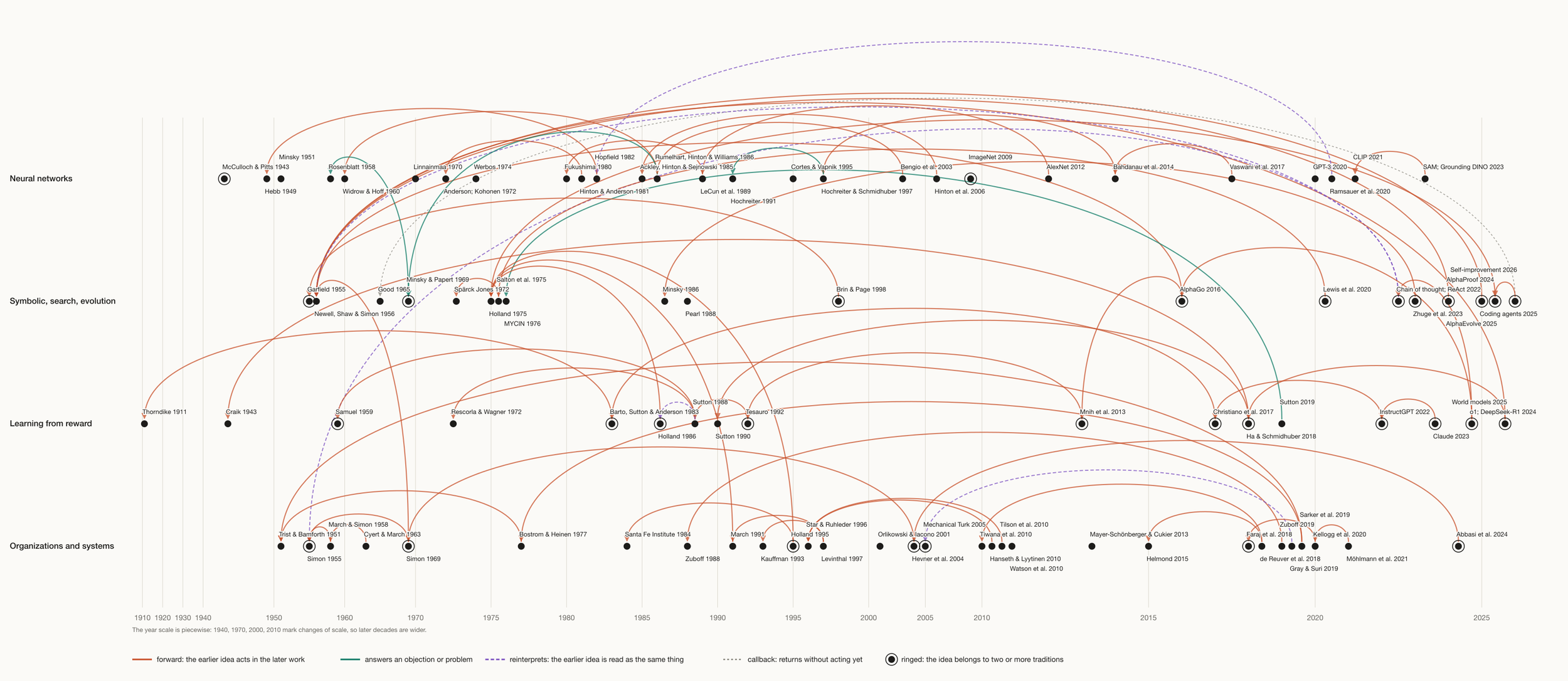
This page goes with the ICIS 2026 frieze. Along its top edge runs a history of the ideas behind today’s AI, in four rows: neural networks; symbolic AI, search and evolution; learning from reward; and organizations and systems, which is where the information systems literature sits.
Each arc joins a later work to an earlier one whose idea it took up. A red arc means the later work used the idea. A blue arc means it explained it, and a black arc means each work drew on the other. A green arc means the later work answered an objection to the earlier one, and a violet arc means it read the earlier idea as the same thing. A grey dashed arc means the idea has come back without yet being put to use. The history is not a straight line of progress. Some ideas were set aside for decades, then came back and became central. Search, from 1956, is used again in AlphaGo and in coding agents. Associative memory, from 1982, is used again in attention. The law of effect, from 1911, is the basis of reinforcement learning.
The same pattern appears in information systems research. Sarker and colleagues (2019) brought the field back to the socio-technical systems of Trist and Bamforth (1951). Abbasi and colleagues (2024) based their proposals for design research on AI on Hevner and colleagues (2004), who drew on Simon's The Sciences of the Artificial (1969).
The bottom row also holds work on three changes that IS research studies closely. The first is work and daily life being recorded as data (Zuboff, 1988 and 2019; Mayer-Schönberger and Cukier, 2013). The second is platforms taking over markets and the organisation of work (Tiwana and colleagues, 2010; Helmond, 2015; de Reuver and colleagues, 2018). The third is algorithms directing workers (Faraj and colleagues, 2018; Kellogg and colleagues, 2020; Möhlmann and colleagues, 2021). Two arcs run from these changes into the history of AI. Crowd workers on an online platform labelled the images on which deep learning was trained. The data that information systems record about work and daily life became training data for AI models.
The key on the frieze uses one term from improvisational theatre. When a later scene brings back something from an earlier one, improvisers call it reincorporation (Johnstone, 1979). The arcs on the timeline mark returns of this kind.
The timeline is a selection made for the frieze. Each work below is followed by its full citation. At the end are the art and design works, shown in ochre on the frieze, the other sources the frieze cites, and the models and data used to make it.
Neural networks
McCulloch & Pitts 1943
McCulloch & Pitts: neurons as logic
McCulloch, W. S., & Pitts, W. (1943). A logical calculus of the ideas immanent in nervous activity. Bulletin of Mathematical Biophysics, 5, 115–133.
Hebb 1949
Hebb: The Organization of Behavior
Later taken up by Hopfield 1982.
Hebb, D. O. (1949). The organization of behavior: A neuropsychological theory. Wiley.
Minsky 1951
Minsky builds SNARC
Minsky, M. L. (1954). Theory of neural-analog reinforcement systems and its application to the brain-model problem [Doctoral dissertation, Princeton University]. SNARC was built with Dean Edmonds in 1951.
Rosenblatt 1958
Rosenblatt: the perceptron
Later taken up by Minsky & Papert 1969.
Rosenblatt, F. (1958). The perceptron: A probabilistic model for information storage and organization in the brain. Psychological Review, 65(6), 386–408.
Widrow & Hoff 1960
Widrow & Hoff: the delta rule
Later taken up by Rumelhart, Hinton & Williams 1986.
Widrow, B., & Hoff, M. E. (1960). Adaptive switching circuits. IRE WESCON Convention Record, Part 4, 96–104.
Linnainmaa 1970
Linnainmaa: reverse-mode differentiation
Linnainmaa, S. (1970). The representation of the cumulative rounding error of an algorithm as a Taylor expansion of the local rounding errors [Master's thesis, University of Helsinki].
Griewank, A. (2012). Who invented the reverse mode of differentiation? Documenta Mathematica, Extra Volume ISMP, 389–400.
Anderson; Kohonen 1972
Anderson; Kohonen: associative memory
Later taken up by Hinton & Anderson 1981.
Anderson, J. A. (1972). A simple neural network generating an interactive memory. Mathematical Biosciences, 14(3–4), 197–220.
Kohonen, T. (1972). Correlation matrix memories. IEEE Transactions on Computers, C-21(4), 353–359.
Werbos 1974
Werbos: backpropagation (thesis)
Werbos, P. J. (1974). Beyond regression: New tools for prediction and analysis in the behavioral sciences [Doctoral dissertation, Harvard University].
Fukushima 1980
Fukushima: the neocognitron
Later taken up by LeCun et al. 1989.
Fukushima, K. (1980). Neocognitron: A self-organizing neural network model for a mechanism of pattern recognition unaffected by shift in position. Biological Cybernetics, 36(4), 193–202.
Hinton & Anderson 1981
Hinton & Anderson: Parallel Models of Associative Memory
- takes up and uses Anderson; Kohonen 1972
Hinton, G. E., & Anderson, J. A. (Eds.). (1981). Parallel models of associative memory. Erlbaum.
Hopfield 1982
Hopfield: networks with an energy
- takes up and uses Hebb 1949 — Hebbian storage in a physical system
Later taken up by Ramsauer et al. 2020.
Hopfield, J. J. (1982). Neural networks and physical systems with emergent collective computational abilities. Proceedings of the National Academy of Sciences, 79(8), 2554–2558.
Ackley, Hinton & Sejnowski 1985
Ackley, Hinton & Sejnowski: Boltzmann machine
Later taken up by Hinton et al. 2006.
Ackley, D. H., Hinton, G. E., & Sejnowski, T. J. (1985). A learning algorithm for Boltzmann machines. Cognitive Science, 9(1), 147–169.
Rumelhart, Hinton & Williams 1986
Rumelhart, Hinton & Williams: backpropagation
- takes up and uses Widrow & Hoff 1960 — the generalized delta rule
- answers Minsky & Papert 1969 — hidden units learn XOR
Later taken up by Bengio et al. 2003.
Rumelhart, D. E., Hinton, G. E., & Williams, R. J. (1986). Learning representations by back-propagating errors. Nature, 323, 533–536.
LeCun et al. 1989
LeCun et al.: convolutional nets
- takes up and uses Fukushima 1980
Later taken up by AlexNet 2012.
LeCun, Y., Boser, B., Denker, J. S., Henderson, D., Howard, R. E., Hubbard, W., & Jackel, L. D. (1989). Backpropagation applied to handwritten zip code recognition. Neural Computation, 1(4), 541–551.
Hochreiter 1991
Hochreiter: vanishing gradients
Later taken up by Hochreiter & Schmidhuber 1997.
Hochreiter, S. (1991). Untersuchungen zu dynamischen neuronalen Netzen [Diploma thesis, Technische Universität München].
Cortes & Vapnik 1995
Cortes & Vapnik: support vector machines
Cortes, C., & Vapnik, V. (1995). Support-vector networks. Machine Learning, 20(3), 273–297.
Hochreiter & Schmidhuber 1997
Hochreiter & Schmidhuber: LSTM
- answers Hochreiter 1991
Later taken up by Bahdanau et al. 2014.
Hochreiter, S., & Schmidhuber, J. (1997). Long short-term memory. Neural Computation, 9(8), 1735–1780.
Bengio et al. 2003
Bengio et al.: neural language model
- takes up and uses Rumelhart, Hinton & Williams 1986 — distributed representations for words
Bengio, Y., Ducharme, R., Vincent, P., & Jauvin, C. (2003). A neural probabilistic language model. Journal of Machine Learning Research, 3, 1137–1155.
Hinton et al. 2006
Hinton, Osindero & Teh: deep belief nets
- takes up and uses Ackley, Hinton & Sejnowski 1985
Hinton, G. E., Osindero, S., & Teh, Y.-W. (2006). A fast learning algorithm for deep belief nets. Neural Computation, 18(7), 1527–1554.
ImageNet 2009
ImageNet; GPU training
Deng, J., Dong, W., Socher, R., Li, L.-J., Li, K., & Fei-Fei, L. (2009). ImageNet: A large-scale hierarchical image database. In Proceedings of the IEEE Conference on Computer Vision and Pattern Recognition (pp. 248–255).
Raina, R., Madhavan, A., & Ng, A. Y. (2009). Large-scale deep unsupervised learning using graphics processors. In Proceedings of the 26th International Conference on Machine Learning (pp. 873–880).
AlexNet 2012
Krizhevsky, Sutskever & Hinton: AlexNet
- takes up and uses LeCun et al. 1989 — the same architecture, scaled
Krizhevsky, A., Sutskever, I., & Hinton, G. E. (2012). ImageNet classification with deep convolutional neural networks. Advances in Neural Information Processing Systems, 25, 1097–1105.
Bahdanau et al. 2014
Sutskever et al.: seq2seq; Bahdanau et al.: attention
- takes up and uses Hochreiter & Schmidhuber 1997
Later taken up by Vaswani et al. 2017.
Sutskever, I., Vinyals, O., & Le, Q. V. (2014). Sequence to sequence learning with neural networks. Advances in Neural Information Processing Systems, 27.
Bahdanau, D., Cho, K., & Bengio, Y. (2014). Neural machine translation by jointly learning to align and translate. arXiv:1409.0473.
Vaswani et al. 2017
Vaswani et al.: the Transformer
- takes up and uses Bahdanau et al. 2014
Vaswani, A., Shazeer, N., Parmar, N., Uszkoreit, J., Jones, L., Gomez, A. N., Kaiser, Ł., & Polosukhin, I. (2017). Attention is all you need. Advances in Neural Information Processing Systems, 30.
GPT-3 2020
Kaplan et al.; Brown et al.: scaling, GPT-3
Kaplan, J., McCandlish, S., Henighan, T., Brown, T. B., Chess, B., Child, R., Gray, S., Radford, A., Wu, J., & Amodei, D. (2020). Scaling laws for neural language models. arXiv:2001.08361.
Brown, T. B., Mann, B., Ryder, N., Subbiah, M., Kaplan, J., Dhariwal, P., Neelakantan, A., Shyam, P., Sastry, G., Askell, A., Agarwal, S., Herbert-Voss, A., Krueger, G., Henighan, T., Child, R., Ramesh, A., Ziegler, D. M., Wu, J., Winter, C., . . . Amodei, D. (2020). Language models are few-shot learners. Advances in Neural Information Processing Systems, 33, 1877–1901.
Ramsauer et al. 2020
Ramsauer et al.: Hopfield networks is all you need
- reads as the same as Hopfield 1982 — attention read as associative memory
Ramsauer, H., Schäfl, B., Lehner, J., Seidl, P., Widrich, M., Adler, T., Gruber, L., Holzleitner, M., Pavlović, M., Sandve, G. K., Greiff, V., Kreil, D., Kopp, M., Klambauer, G., Brandstetter, J., & Hochreiter, S. (2021). Hopfield networks is all you need. In International Conference on Learning Representations. arXiv:2008.02217.
CLIP 2021
Radford et al.: CLIP an ancestor of an instrument used to make the frieze
Later taken up by SAM; Grounding DINO 2023.
Radford, A., Kim, J. W., Hallacy, C., Ramesh, A., Goh, G., Agarwal, S., Sastry, G., Askell, A., Mishkin, P., Clark, J., Krueger, G., & Sutskever, I. (2021). Learning transferable visual models from natural language supervision. In Proceedings of the 38th International Conference on Machine Learning (PMLR 139, pp. 8748–8763).
SAM; Grounding DINO 2023
Kirillov et al.: Segment Anything; Liu et al.: Grounding DINO an ancestor of an instrument used to make the frieze
- takes up and uses CLIP 2021
Kirillov, A., Mintun, E., Ravi, N., Mao, H., Rolland, C., Gustafson, L., Xiao, T., Whitehead, S., Berg, A. C., Lo, W.-Y., Dollár, P., & Girshick, R. (2023). Segment anything. In Proceedings of the IEEE/CVF International Conference on Computer Vision (pp. 4015–4026).
Liu, S., Zeng, Z., Ren, T., Li, F., Zhang, H., Yang, J., Jiang, Q., Li, C., Yang, J., Su, H., Zhu, J., & Zhang, L. (2023). Grounding DINO: Marrying DINO with grounded pre-training for open-set object detection. arXiv:2303.05499.
Ravi, N., Gabeur, V., Hu, Y.-T., Hu, R., Ryali, C., Ma, T., Khedr, H., Rädle, R., Rolland, C., Gustafson, L., Mintun, E., Pan, J., Alwala, K. V., Carion, N., Wu, C.-Y., Girshick, R., Dollár, P., & Feichtenhofer, C. (2024). SAM 2: Segment anything in images and videos. arXiv:2408.00714.
Symbolic, search, evolution
Garfield 1955
Garfield: citation indexes for science
Later taken up by Brin & Page 1998.
Garfield, E. (1955). Citation indexes for science: A new dimension in documentation through association of ideas. Science, 122(3159), 108–111.
Newell, Shaw & Simon 1956
Logic Theorist; Dartmouth
Later taken up by AlphaGo 2016, Chain of thought; ReAct 2022, AlphaProof 2024, Coding agents 2025, World models 2025, Simon 1969.
McCarthy, J., Minsky, M. L., Rochester, N., & Shannon, C. E. (1955). A proposal for the Dartmouth summer research project on artificial intelligence.
Newell, A., & Simon, H. A. (1956). The logic theory machine: A complex information processing system. IRE Transactions on Information Theory, 2(3), 61–79.
Good 1965
Good: the intelligence explosion
Later taken up by Self-improvement 2026.
Good, I. J. (1965). Speculations concerning the first ultraintelligent machine. Advances in Computers, 6, 31–88.
Minsky & Papert 1969
Minsky & Papert: Perceptrons
- answers Rosenblatt 1958 — the critique of the perceptron
Later taken up by Rumelhart, Hinton & Williams 1986.
Minsky, M., & Papert, S. (1969). Perceptrons: An introduction to computational geometry. MIT Press.
Spärck Jones 1972
Spärck Jones: term specificity (IDF) an ancestor of an instrument used to make the frieze
Later taken up by Salton et al. 1975.
Spärck Jones, K. (1972). A statistical interpretation of term specificity and its application in retrieval. Journal of Documentation, 28(1), 11–21.
Holland 1975
Holland: genetic algorithms
Later taken up by AlphaEvolve 2025, Holland 1986, Holland 1995, March 1991.
Holland, J. H. (1975). Adaptation in natural and artificial systems. University of Michigan Press.
Salton et al. 1975
Salton, Wong & Yang: a vector space model
- takes up and uses Spärck Jones 1972
Later taken up by Lewis et al. 2020.
Salton, G., Wong, A., & Yang, C. S. (1975). A vector space model for automatic indexing. Communications of the ACM, 18(11), 613–620.
MYCIN 1976
Expert systems (MYCIN)
Later taken up by Sutton 2019.
Shortliffe, E. H. (1976). Computer-based medical consultations: MYCIN. Elsevier.
Minsky 1986
Minsky: The Society of Mind
Later taken up by Zhuge et al. 2023.
Minsky, M. (1986). The society of mind. Simon & Schuster.
Pearl 1988
Pearl: Bayesian networks
Pearl, J. (1988). Probabilistic reasoning in intelligent systems: Networks of plausible inference. Morgan Kaufmann.
Brin & Page 1998
Brin & Page: the anatomy of a web search engine
- takes up and uses Garfield 1955 — links read as citations
Brin, S., & Page, L. (1998). The anatomy of a large-scale hypertextual Web search engine. Computer Networks and ISDN Systems, 30(1–7), 107–117.
AlphaGo 2016
Silver et al.: AlphaGo
- takes up and uses Newell, Shaw & Simon 1956 — search returns, guided by networks
- takes up and uses Mnih et al. 2013
Later taken up by o1; DeepSeek-R1 2024.
Silver, D., Huang, A., Maddison, C. J., Guez, A., Sifre, L., van den Driessche, G., Schrittwieser, J., Antonoglou, I., Panneershelvam, V., Lanctot, M., Dieleman, S., Grewe, D., Nham, J., Kalchbrenner, N., Sutskever, I., Lillicrap, T., Leach, M., Kavukcuoglu, K., Graepel, T., & Hassabis, D. (2016). Mastering the game of Go with deep neural networks and tree search. Nature, 529, 484–489. https://doi.org/10.1038/nature16961
Lewis et al. 2020
Lewis et al.: retrieval-augmented generation
- takes up and uses Salton et al. 1975 — retrieval returns inside generation
Lewis, P., Perez, E., Piktus, A., Petroni, F., Karpukhin, V., Goyal, N., Küttler, H., Lewis, M., Yih, W.-t., Rocktäschel, T., Riedel, S., & Kiela, D. (2020). Retrieval-augmented generation for knowledge-intensive NLP tasks. Advances in Neural Information Processing Systems, 33, 9459–9474.
Chain of thought; ReAct 2022
Wei et al.: chain of thought; Yao et al.: ReAct
- reads as the same as Newell, Shaw & Simon 1956 — explicit reasoning steps, in text
- reads as the same as Simon 1955 — agents that satisfice: our reading
Later taken up by o1; DeepSeek-R1 2024.
Wei, J., Wang, X., Schuurmans, D., Bosma, M., Ichter, B., Xia, F., Chi, E., Le, Q., & Zhou, D. (2022). Chain-of-thought prompting elicits reasoning in large language models. Advances in Neural Information Processing Systems, 35.
Yao, S., Zhao, J., Yu, D., Du, N., Shafran, I., Narasimhan, K., & Cao, Y. (2023). ReAct: Synergizing reasoning and acting in language models. In International Conference on Learning Representations. arXiv:2210.03629.
Zhuge et al. 2023
Zhuge et al.: natural-language societies of mind
- takes up and uses Minsky 1986
Zhuge, M., Liu, H., Faccio, F., Ashley, D. R., Csordás, R., Gopalakrishnan, A., Hamdi, A., Hammoud, H. A. A. K., Herrmann, V., Irie, K., Kirsch, L., Li, B., Li, G., Liu, S., Mai, J., Piękos, P., Ramesh, A., Schlag, I., Shi, W., . . . Schmidhuber, J. (2023). Mindstorms in natural language-based societies of mind. arXiv:2305.17066.
AlphaProof 2024
AlphaProof: proofs in Lean
- takes up and uses Newell, Shaw & Simon 1956 — the Logic Theorist's goal, 68 years on
Google DeepMind. (2024, July 25). AI achieves silver-medal standard solving International Mathematical Olympiad problems. https://deepmind.google/discover/blog/
Coding agents 2025
Coding agents
- takes up and uses Newell, Shaw & Simon 1956 — symbolic machinery as the model's checker
Yang, J., Jimenez, C. E., Wettig, A., Lieret, K., Yao, S., Narasimhan, K., & Press, O. (2024). SWE-agent: Agent-computer interfaces enable automated software engineering. Advances in Neural Information Processing Systems, 37.
Coding agents in daily use from 2025, such as Claude Code (Anthropic) and Codex (OpenAI).
AlphaEvolve 2025
AlphaEvolve
- takes up and uses Holland 1975
Later taken up by Self-improvement 2026.
Novikov, A., Vũ, N., Eisenberger, M., Dupont, E., Huang, P.-S., Wagner, A. Z., Shirobokov, S., Kozlovskii, B., Ruiz, F. J. R., Mehrabian, A., Kumar, M. P., See, A., Chaudhuri, S., Holland, G., Davies, A., Nowozin, S., Kohli, P., & Balog, M. (2025). AlphaEvolve: A coding agent for scientific and algorithmic discovery. arXiv:2506.13131.
Self-improvement 2026
Recursive self-improvement as a goal
- returns to, without yet acting on Good 1965 — the idea returns as a goal; no working mechanism yet
- takes up and uses AlphaEvolve 2025
Duan, Y., Liu, Y., Tang, Z., Chen, H., Zhou, J., Liu, Y., Xu, B., Wu, Y., Chen, S., Zhou, Y., Wang, H., Yu, X., Han, S., Zhu, X., Zhou, Lu, B., Zhou, W., Liu, J., Fang, N., . . . Wu, F. (2026). The last AI built by humans: Toward genuine recursive self-improvement. arXiv:2609.11873.
Wu, S., Ren, J., Li, Y., Li, H.-S., Yang, C., Zhang, Y., Gu, W., Yang, J., Batista-Navarro, R., Zhang, C., Liu, X., Zhou, M., Dai, B., & Lin, C. (2026). ModularRSI: Modular and generalizable recursive harness self-improvement. arXiv:2609.14857.
Learning from reward
Thorndike 1911
Thorndike: the law of effect
Later taken up by Barto, Sutton & Anderson 1983.
Thorndike, E. L. (1911). Animal intelligence: Experimental studies. Macmillan.
Craik 1943
Craik: The Nature of Explanation
Later taken up by Ha & Schmidhuber 2018.
Craik, K. J. W. (1943). The nature of explanation. Cambridge University Press.
Samuel 1959
Samuel: checkers that learns
Later taken up by Sutton 1988.
Samuel, A. L. (1959). Some studies in machine learning using the game of checkers. IBM Journal of Research and Development, 3(3), 210–229.
Rescorla & Wagner 1972
Rescorla & Wagner: prediction error
Later taken up by Sutton 1988.
Rescorla, R. A., & Wagner, A. R. (1972). A theory of Pavlovian conditioning: Variations in the effectiveness of reinforcement and nonreinforcement. In A. H. Black & W. F. Prokasy (Eds.), Classical conditioning II: Current research and theory (pp. 64–99). Appleton-Century-Crofts.
Barto, Sutton & Anderson 1983
Barto, Sutton & Anderson: adaptive elements
- takes up and uses Thorndike 1911 — the law of effect, 72 years on
Later taken up by Christiano et al. 2017.
Barto, A. G., Sutton, R. S., & Anderson, C. W. (1983). Neuronlike adaptive elements that can solve difficult learning control problems. IEEE Transactions on Systems, Man, and Cybernetics, 13(5), 834–846.
Holland 1986
Holland: escaping brittleness (classifier systems)
- takes up and uses Holland 1975
Later taken up by Sutton 1988.
Holland, J. H. (1986). Escaping brittleness: The possibilities of general-purpose learning algorithms applied to parallel rule-based systems. In R. S. Michalski, J. G. Carbonell, & T. M. Mitchell (Eds.), Machine learning: An artificial intelligence approach (Vol. 2, pp. 593–623). Morgan Kaufmann.
Sutton 1988
Sutton: temporal-difference learning
- takes up and uses Rescorla & Wagner 1972
- takes up and uses Samuel 1959
- reads as the same as Holland 1986 — the bucket brigade read as TD
Later taken up by Tesauro 1992.
Sutton, R. S. (1988). Learning to predict by the methods of temporal differences. Machine Learning, 3(1), 9–44.
Sutton 1990
Sutton: Dyna
Later taken up by Ha & Schmidhuber 2018.
Sutton, R. S. (1990). Integrated architectures for learning, planning, and reacting based on approximating dynamic programming. In Proceedings of the Seventh International Conference on Machine Learning (pp. 216–224). Morgan Kaufmann.
Tesauro 1992
Tesauro: TD-Gammon
- takes up and uses Sutton 1988
Later taken up by Mnih et al. 2013.
Tesauro, G. (1992). Practical issues in temporal difference learning. Machine Learning, 8(3–4), 257–277.
Mnih et al. 2013
Mnih et al.: deep Q-networks
- takes up and uses Tesauro 1992
Later taken up by AlphaGo 2016.
Mnih, V., Kavukcuoglu, K., Silver, D., Graves, A., Antonoglou, I., Wierstra, D., & Riedmiller, M. (2013). Playing Atari with deep reinforcement learning. arXiv:1312.5602.
Christiano et al. 2017
Christiano et al.: RL from human preferences
- takes up and uses Barto, Sutton & Anderson 1983
Later taken up by InstructGPT 2022.
Christiano, P. F., Leike, J., Brown, T., Martic, M., Legg, S., & Amodei, D. (2017). Deep reinforcement learning from human preferences. Advances in Neural Information Processing Systems, 30.
Ha & Schmidhuber 2018
Ha & Schmidhuber: world models
- takes up and uses Sutton 1990
- takes up and uses Craik 1943 — Craik's small-scale model, 75 years on
Later taken up by World models 2025.
Ha, D., & Schmidhuber, J. (2018). World models. arXiv:1803.10122.
Sutton 2019
Sutton: The Bitter Lesson
- answers MYCIN 1976
Sutton, R. S. (2019, March 13). The bitter lesson. http://www.incompleteideas.net/IncIdeas/BitterLesson.html
InstructGPT 2022
Ouyang et al.: InstructGPT; ChatGPT
- takes up and uses Christiano et al. 2017
Later taken up by Claude 2023.
Ouyang, L., Wu, J., Jiang, X., Almeida, D., Wainwright, C. L., Mishkin, P., Zhang, C., Agarwal, S., Slama, K., Ray, A., Schulman, J., Hilton, J., Kelton, F., Miller, L., Simens, M., Askell, A., Welinder, P., Christiano, P., Leike, J., & Lowe, R. (2022). Training language models to follow instructions with human feedback. Advances in Neural Information Processing Systems, 35.
OpenAI. (2022, November 30). Introducing ChatGPT. https://openai.com/index/chatgpt/
Claude 2023
Bai et al.: constitutional AI; Claude an ancestor of an instrument used to make the frieze
- takes up and uses InstructGPT 2022
Bai, Y., Kadavath, S., Kundu, S., Askell, A., Kernion, J., Jones, A., Chen, A., Goldie, A., Mirhoseini, A., McKinnon, C., Chen, C., Olsson, C., Olah, C., Hernandez, D., Drain, D., Ganguli, D., Li, D., Tran-Johnson, E., Perez, E., . . . Kaplan, J. (2022). Constitutional AI: Harmlessness from AI feedback. arXiv:2212.08073.
Anthropic. (2023, March 14). Introducing Claude. https://www.anthropic.com/news/introducing-claude
o1; DeepSeek-R1 2024
Reasoning models: o1; DeepSeek-R1
- takes up and uses AlphaGo 2016
- takes up and uses Chain of thought; ReAct 2022
OpenAI. (2024, September 12). Learning to reason with LLMs. https://openai.com/index/learning-to-reason-with-llms/
DeepSeek-AI. (2025). DeepSeek-R1: Incentivizing reasoning capability in LLMs via reinforcement learning. arXiv:2501.12948.
World models 2025
World models now (Genie 3; programs as world models)
- takes up and uses Ha & Schmidhuber 2018
- takes up and uses Newell, Shaw & Simon 1956 — world models written as programs; provisional
Google DeepMind. (2025, August 5). Genie 3: A new frontier for world models. https://deepmind.google/discover/blog/
Safron, A., Levin, M., Klimaj, V., Sheikhbahaee, Z., Sakthivadivel, D., Razi, A., Ha, D., Hay, N., Schmidt, K., Rish, I., Krakauer, D., Mitchell, M., Gershman, S. J., & Tenenbaum, J. B. (2026). World models, artificial general intelligence and the hard problems of life–mind continuity: Toward a unified understanding of natural and artificial intelligence. Philosophical Transactions of the Royal Society A, 384(2320), 20240533. https://doi.org/10.1098/rsta.2024.0533
Tsividis, P., Loula, J., Burga, J., Rodriguez, J. P., Arnaud, S., Foss, N., Campero, A., Subramanian, A., Pouncy, T., Gershman, S. J., & Tenenbaum, J. B. (2026). Human-level learning of complex novel tasks as theory-based modelling, exploration and planning. Philosophical Transactions of the Royal Society A, 384(2320), 20240529. https://doi.org/10.1098/rsta.2024.0529
Organizations and systems
Trist & Bamforth 1951
Trist & Bamforth: the longwall method of coal-getting
Later taken up by Bostrom & Heinen 1977, Sarker et al. 2019.
Trist, E. L., & Bamforth, K. W. (1951). Some social and psychological consequences of the longwall method of coal-getting. Human Relations, 4(1), 3–38.
Simon 1955
Simon: a behavioral model of rational choice
Later taken up by March & Simon 1958, Simon 1969, Chain of thought; ReAct 2022.
Simon, H. A. (1955). A behavioral model of rational choice. Quarterly Journal of Economics, 69(1), 99–118.
March & Simon 1958
March & Simon: Organizations
- takes up and uses Simon 1955
Later taken up by Cyert & March 1963.
March, J. G., & Simon, H. A. (1958). Organizations. Wiley.
Cyert & March 1963
Cyert & March: A Behavioral Theory of the Firm
- takes up and uses March & Simon 1958
Cyert, R. M., & March, J. G. (1963). A behavioral theory of the firm. Prentice-Hall.
Simon 1969
Simon: The Sciences of the Artificial
- takes up and uses Simon 1955
- takes up and uses Newell, Shaw & Simon 1956 — design as search
Later taken up by Hevner et al. 2004.
Simon, H. A. (1969). The sciences of the artificial. MIT Press.
Bostrom & Heinen 1977
Bostrom & Heinen: MIS problems and failures, a socio-technical perspective
- takes up and uses Trist & Bamforth 1951
Later taken up by Sarker et al. 2019.
Bostrom, R. P., & Heinen, J. S. (1977). MIS problems and failures: A socio-technical perspective. Part I: The causes. MIS Quarterly, 1(3), 17–32.
Santa Fe Institute 1984
The Santa Fe Institute is founded
Later taken up by Holland 1995.
Santa Fe Institute (founded 1984), Santa Fe, New Mexico. https://www.santafe.edu
Zuboff 1988
Zuboff: In the Age of the Smart Machine
Later taken up by Zuboff 2019.
Zuboff, S. (1988). In the age of the smart machine: The future of work and power. Basic Books.
March 1991
March: exploration and exploitation in organizational learning
- takes up and uses Holland 1975 — exploration and exploitation, after Holland; to check
Later taken up by Levinthal 1997.
March, J. G. (1991). Exploration and exploitation in organizational learning. Organization Science, 2(1), 71–87.
Kauffman 1993
Kauffman: The Origins of Order
Later taken up by Levinthal 1997.
Kauffman, S. A. (1993). The origins of order: Self-organization and selection in evolution. Oxford University Press.
Star & Ruhleder 1996
Star & Ruhleder: steps toward an ecology of infrastructure
Later taken up by Hanseth & Lyytinen 2010, Tilson et al. 2010.
Star, S. L., & Ruhleder, K. (1996). Steps toward an ecology of infrastructure: Design and access for large information spaces. Information Systems Research, 7(1), 111–134.
Levinthal 1997
Levinthal: adaptation on rugged landscapes
- takes up and uses Kauffman 1993 — the NK model enters organization theory
- takes up and uses March 1991
Levinthal, D. A. (1997). Adaptation on rugged landscapes. Management Science, 43(7), 934–950.
Orlikowski & Iacono 2001
Orlikowski & Iacono: desperately seeking the IT in IT research
Orlikowski, W. J., & Iacono, C. S. (2001). Research commentary: Desperately seeking the “IT” in IT research—A call to theorizing the IT artifact. Information Systems Research, 12(2), 121–134.
Hevner et al. 2004
Hevner, March, Park & Ram: design science in IS research
- takes up and uses Simon 1969
Later taken up by Abbasi et al. 2024.
Hevner, A. R., March, S. T., Park, J., & Ram, S. (2004). Design science in information systems research. MIS Quarterly, 28(1), 75–105.
Mechanical Turk 2005
Amazon Mechanical Turk opens
Later taken up by Gray & Suri 2019.
Amazon Mechanical Turk (opened to the public 2005). https://www.mturk.com
Tiwana et al. 2010
Tiwana, Konsynski & Bush: platform evolution
Later taken up by de Reuver et al. 2018.
Tiwana, A., Konsynski, B., & Bush, A. A. (2010). Platform evolution: Coevolution of platform architecture, governance, and environmental dynamics. Information Systems Research, 21(4), 675–687.
Hanseth & Lyytinen 2010
Hanseth & Lyytinen: design theory for dynamic complexity in information infrastructures
- takes up and uses Star & Ruhleder 1996
Hanseth, O., & Lyytinen, K. (2010). Design theory for dynamic complexity in information infrastructures: The case of building internet. Journal of Information Technology, 25(1), 1–19.
Tilson et al. 2010
Tilson, Lyytinen & Sørensen: digital infrastructures
- takes up and uses Star & Ruhleder 1996
Tilson, D., Lyytinen, K., & Sørensen, C. (2010). Digital infrastructures: The missing IS research agenda. Information Systems Research, 21(4), 748–759.
Watson et al. 2010
Watson, Boudreau & Chen: energy informatics
Watson, R. T., Boudreau, M.-C., & Chen, A. J. (2010). Information systems and environmentally sustainable development: Energy informatics and new directions for the IS community. MIS Quarterly, 34(1), 23–38.
Mayer-Schönberger & Cukier 2013
Mayer-Schönberger & Cukier: Big Data (datafication)
Mayer-Schönberger, V., & Cukier, K. (2013). Big data: A revolution that will transform how we live, work, and think. Houghton Mifflin Harcourt.
Helmond 2015
Helmond: the platformization of the web
Later taken up by de Reuver et al. 2018.
Helmond, A. (2015). The platformization of the web: Making web data platform ready. Social Media + Society, 1(2).
Faraj et al. 2018
Faraj, Pachidi & Sayegh: working and organizing in the age of the learning algorithm
Later taken up by Kellogg et al. 2020.
Faraj, S., Pachidi, S., & Sayegh, K. (2018). Working and organizing in the age of the learning algorithm. Information and Organization, 28(1), 62–70.
de Reuver et al. 2018
de Reuver, Sørensen & Basole: the digital platform
- takes up and uses Tiwana et al. 2010
- takes up and uses Helmond 2015
de Reuver, M., Sørensen, C., & Basole, R. C. (2018). The digital platform: A research agenda. Journal of Information Technology, 33(2), 124–135.
Zuboff 2019
Zuboff: The Age of Surveillance Capitalism
- takes up and uses Zuboff 1988 — informate becomes behavioural surplus
Zuboff, S. (2019). The age of surveillance capitalism: The fight for a human future at the new frontier of power. PublicAffairs.
Gray & Suri 2019
Gray & Suri: Ghost Work
- reads as the same as Mechanical Turk 2005 — the labour behind the datasets
Gray, M. L., & Suri, S. (2019). Ghost work: How to stop Silicon Valley from building a new global underclass. Houghton Mifflin Harcourt.
Sarker et al. 2019
Sarker, Chatterjee, Xiao & Elbanna: the sociotechnical axis of cohesion
- takes up and uses Trist & Bamforth 1951 — IS returns to its socio-technical origin
- takes up and uses Bostrom & Heinen 1977
Sarker, S., Chatterjee, S., Xiao, X., & Elbanna, A. (2019). The sociotechnical axis of cohesion for the IS discipline: Its historical legacy and its continued relevance. MIS Quarterly, 43(3), 695–719.
Kellogg et al. 2020
Kellogg, Valentine & Christin: algorithms at work
- takes up and uses Faraj et al. 2018
Later taken up by Möhlmann et al. 2021.
Kellogg, K. C., Valentine, M. A., & Christin, A. (2020). Algorithms at work: The new contested terrain of control. Academy of Management Annals, 14(1), 366–410.
Möhlmann et al. 2021
Möhlmann, Zalmanson, Henfridsson & Gregory: algorithmic management
- takes up and uses Kellogg et al. 2020
Möhlmann, M., Zalmanson, L., Henfridsson, O., & Gregory, R. W. (2021). Algorithmic management of work on online labor platforms: When matching meets control. MIS Quarterly, 45(4), 1999–2022.
Abbasi et al. 2024
Abbasi, Parsons, Pant, Sheng & Sarker: pathways for design research on AI
- takes up and uses Hevner et al. 2004 — design research, now on AI
Abbasi, A., Parsons, J., Pant, G., Sheng, O. R. L., & Sarker, S. (2024). Pathways for design research on artificial intelligence. Information Systems Research, 35(2), 441–459.
Personal notes
Lyytinen, Nickerson & King (2021), “Metahuman systems = humans + machines that learn,” Journal of Information Technology: where my own work joins this line.
Art and design
These works run along the timeline in ochre. A dotted line ties each to the station of the frieze that takes it up.
- Lönberg-Holm, K., & Sutnar, L. (1944). Catalog design. Sweet's Catalog Service.
- Burtin, W. (art director, from 1948). Scope [magazine]. The Upjohn Company.
- Bayer, H. (1953). World geo-graphic atlas: A composite of man's environment. Container Corporation of America.
- Becher, B., & Becher, H. (1970). Anonyme Skulpturen: Eine Typologie technischer Bauten. Art-Press Verlag.
- Weingart, W. (2000). My way to typography. Lars Müller Publishers. (The layered type of the early 1970s at the Basel school.)
- Friedlander, L. (1976). The American monument. The Eakins Press Foundation.
- Greiman, A. (1986). Does it make sense? Design Quarterly, 133. Walker Art Center and MIT Press.
- Struth, T. (1987). Unbewusste Orte / Unconscious places [Exhibition catalogue]. Kunsthalle Bern.
- Lombardi, M. (1994–2000). Narrative structures [Drawings]. See Hobbs, R. (2003). Mark Lombardi: Global networks. Independent Curators International.
- Tillmans, W. (2000). Installation for the Turner Prize exhibition [Installation]. Tate Britain, London.
Other sources the frieze cites
- Avital, M., Mathiassen, L., & Schultze, U. (2017). Alternative genres in information systems research. European Journal of Information Systems, 26(3), 240–247.
- Crawford, K., & Joler, V. (2018). Anatomy of an AI system. AI Now Institute and Share Lab.
- Farocki, H. (2003). Eye/Machine III [Video installation].
- Johnstone, K. (1979). Impro: Improvisation and the theatre. Faber and Faber.
- Lyytinen, K., Nickerson, J. V., & King, J. L. (2021). Metahuman systems = humans + machines that learn. Journal of Information Technology, 36(4), 427–445.
- Paglen, T. (2016, December 8). Invisible images (your pictures are looking at you). The New Inquiry.
- Seidel, S., Berente, N., Lindberg, A., Lyytinen, K., & Nickerson, J. V. (2019). Autonomous tools and design: A triple-loop approach to human-machine learning. Communications of the ACM, 62(1), 50–57.
How the frieze was made
- Parts: Grounding DINO (Liu et al., 2023) finds the equipment named in each photograph, and SAM 2.1 (Ravi et al., 2024) cuts it out.
- Phrases: the most distinctive terms (TF-IDF; Spärck Jones, 1972) of five years (2021–2026) of IS journal abstracts, arXiv abstracts in cs.AI and cs.CY, and Hacker News titles, each placed near the photograph that CLIP ViT-L/14 (Radford et al., 2021) matches it to.
- Diagrams and type: TikZ and XeLaTeX, set in Helvetica Neue.
- The crystal of agents: a diamond lattice grown by a simple rule and rendered in Blender (Cycles).
All references
- Abbasi, A., Parsons, J., Pant, G., Sheng, O. R. L., & Sarker, S. (2024). Pathways for design research on artificial intelligence. Information Systems Research, 35(2), 441–459.
- Ackley, D. H., Hinton, G. E., & Sejnowski, T. J. (1985). A learning algorithm for Boltzmann machines. Cognitive Science, 9(1), 147–169.
- Anderson, J. A. (1972). A simple neural network generating an interactive memory. Mathematical Biosciences, 14(3–4), 197–220.
- Anthropic. (2023, March 14). Introducing Claude. https://www.anthropic.com/news/introducing-claude
- Avital, M., Mathiassen, L., & Schultze, U. (2017). Alternative genres in information systems research. European Journal of Information Systems, 26(3), 240–247.
- Bahdanau, D., Cho, K., & Bengio, Y. (2014). Neural machine translation by jointly learning to align and translate. arXiv:1409.0473.
- Bai, Y., Kadavath, S., Kundu, S., Askell, A., Kernion, J., Jones, A., Chen, A., Goldie, A., Mirhoseini, A., McKinnon, C., Chen, C., Olsson, C., Olah, C., Hernandez, D., Drain, D., Ganguli, D., Li, D., Tran-Johnson, E., Perez, E., . . . Kaplan, J. (2022). Constitutional AI: Harmlessness from AI feedback. arXiv:2212.08073.
- Barto, A. G., Sutton, R. S., & Anderson, C. W. (1983). Neuronlike adaptive elements that can solve difficult learning control problems. IEEE Transactions on Systems, Man, and Cybernetics, 13(5), 834–846.
- Bayer, H. (1953). World geo-graphic atlas: A composite of man's environment. Container Corporation of America.
- Becher, B., & Becher, H. (1970). Anonyme Skulpturen: Eine Typologie technischer Bauten. Art-Press Verlag.
- Bengio, Y., Ducharme, R., Vincent, P., & Jauvin, C. (2003). A neural probabilistic language model. Journal of Machine Learning Research, 3, 1137–1155.
- Bostrom, R. P., & Heinen, J. S. (1977). MIS problems and failures: A socio-technical perspective. Part I: The causes. MIS Quarterly, 1(3), 17–32.
- Brin, S., & Page, L. (1998). The anatomy of a large-scale hypertextual Web search engine. Computer Networks and ISDN Systems, 30(1–7), 107–117.
- Brown, T. B., Mann, B., Ryder, N., Subbiah, M., Kaplan, J., Dhariwal, P., Neelakantan, A., Shyam, P., Sastry, G., Askell, A., Agarwal, S., Herbert-Voss, A., Krueger, G., Henighan, T., Child, R., Ramesh, A., Ziegler, D. M., Wu, J., Winter, C., . . . Amodei, D. (2020). Language models are few-shot learners. Advances in Neural Information Processing Systems, 33, 1877–1901.
- Christiano, P. F., Leike, J., Brown, T., Martic, M., Legg, S., & Amodei, D. (2017). Deep reinforcement learning from human preferences. Advances in Neural Information Processing Systems, 30.
- Cortes, C., & Vapnik, V. (1995). Support-vector networks. Machine Learning, 20(3), 273–297.
- Craik, K. J. W. (1943). The nature of explanation. Cambridge University Press.
- Crawford, K., & Joler, V. (2018). Anatomy of an AI system. AI Now Institute and Share Lab.
- Cyert, R. M., & March, J. G. (1963). A behavioral theory of the firm. Prentice-Hall.
- de Reuver, M., Sørensen, C., & Basole, R. C. (2018). The digital platform: A research agenda. Journal of Information Technology, 33(2), 124–135.
- DeepSeek-AI. (2025). DeepSeek-R1: Incentivizing reasoning capability in LLMs via reinforcement learning. arXiv:2501.12948.
- Deng, J., Dong, W., Socher, R., Li, L.-J., Li, K., & Fei-Fei, L. (2009). ImageNet: A large-scale hierarchical image database. In Proceedings of the IEEE Conference on Computer Vision and Pattern Recognition (pp. 248–255).
- Duan, Y., Liu, Y., Tang, Z., Chen, H., Zhou, J., Liu, Y., Xu, B., Wu, Y., Chen, S., Zhou, Y., Wang, H., Yu, X., Han, S., Zhu, X., Zhou, Lu, B., Zhou, W., Liu, J., Fang, N., . . . Wu, F. (2026). The last AI built by humans: Toward genuine recursive self-improvement. arXiv:2609.11873.
- Faraj, S., Pachidi, S., & Sayegh, K. (2018). Working and organizing in the age of the learning algorithm. Information and Organization, 28(1), 62–70.
- Farocki, H. (2003). Eye/Machine III [Video installation].
- Friedlander, L. (1976). The American monument. The Eakins Press Foundation.
- Fukushima, K. (1980). Neocognitron: A self-organizing neural network model for a mechanism of pattern recognition unaffected by shift in position. Biological Cybernetics, 36(4), 193–202.
- Garfield, E. (1955). Citation indexes for science: A new dimension in documentation through association of ideas. Science, 122(3159), 108–111.
- Good, I. J. (1965). Speculations concerning the first ultraintelligent machine. Advances in Computers, 6, 31–88.
- Google DeepMind. (2024, July 25). AI achieves silver-medal standard solving International Mathematical Olympiad problems. https://deepmind.google/discover/blog/
- Google DeepMind. (2025, August 5). Genie 3: A new frontier for world models. https://deepmind.google/discover/blog/
- Gray, M. L., & Suri, S. (2019). Ghost work: How to stop Silicon Valley from building a new global underclass. Houghton Mifflin Harcourt.
- Greiman, A. (1986). Does it make sense? Design Quarterly, 133. Walker Art Center and MIT Press.
- Griewank, A. (2012). Who invented the reverse mode of differentiation? Documenta Mathematica, Extra Volume ISMP, 389–400.
- Ha, D., & Schmidhuber, J. (2018). World models. arXiv:1803.10122.
- Hanseth, O., & Lyytinen, K. (2010). Design theory for dynamic complexity in information infrastructures: The case of building internet. Journal of Information Technology, 25(1), 1–19.
- Hebb, D. O. (1949). The organization of behavior: A neuropsychological theory. Wiley.
- Helmond, A. (2015). The platformization of the web: Making web data platform ready. Social Media + Society, 1(2).
- Hevner, A. R., March, S. T., Park, J., & Ram, S. (2004). Design science in information systems research. MIS Quarterly, 28(1), 75–105.
- Hinton, G. E., & Anderson, J. A. (Eds.). (1981). Parallel models of associative memory. Erlbaum.
- Hinton, G. E., Osindero, S., & Teh, Y.-W. (2006). A fast learning algorithm for deep belief nets. Neural Computation, 18(7), 1527–1554.
- Hochreiter, S. (1991). Untersuchungen zu dynamischen neuronalen Netzen [Diploma thesis, Technische Universität München].
- Hochreiter, S., & Schmidhuber, J. (1997). Long short-term memory. Neural Computation, 9(8), 1735–1780.
- Holland, J. H. (1975). Adaptation in natural and artificial systems. University of Michigan Press.
- Holland, J. H. (1986). Escaping brittleness: The possibilities of general-purpose learning algorithms applied to parallel rule-based systems. In R. S. Michalski, J. G. Carbonell, & T. M. Mitchell (Eds.), Machine learning: An artificial intelligence approach (Vol. 2, pp. 593–623). Morgan Kaufmann.
- Holland, J. H. (1995). Hidden order: How adaptation builds complexity. Addison-Wesley.
- Hopfield, J. J. (1982). Neural networks and physical systems with emergent collective computational abilities. Proceedings of the National Academy of Sciences, 79(8), 2554–2558.
- Johnstone, K. (1979). Impro: Improvisation and the theatre. Faber and Faber.
- Kaplan, J., McCandlish, S., Henighan, T., Brown, T. B., Chess, B., Child, R., Gray, S., Radford, A., Wu, J., & Amodei, D. (2020). Scaling laws for neural language models. arXiv:2001.08361.
- Kauffman, S. A. (1993). The origins of order: Self-organization and selection in evolution. Oxford University Press.
- Kellogg, K. C., Valentine, M. A., & Christin, A. (2020). Algorithms at work: The new contested terrain of control. Academy of Management Annals, 14(1), 366–410.
- Kirillov, A., Mintun, E., Ravi, N., Mao, H., Rolland, C., Gustafson, L., Xiao, T., Whitehead, S., Berg, A. C., Lo, W.-Y., Dollár, P., & Girshick, R. (2023). Segment anything. In Proceedings of the IEEE/CVF International Conference on Computer Vision (pp. 4015–4026).
- Kohonen, T. (1972). Correlation matrix memories. IEEE Transactions on Computers, C-21(4), 353–359.
- Krizhevsky, A., Sutskever, I., & Hinton, G. E. (2012). ImageNet classification with deep convolutional neural networks. Advances in Neural Information Processing Systems, 25, 1097–1105.
- LeCun, Y., Boser, B., Denker, J. S., Henderson, D., Howard, R. E., Hubbard, W., & Jackel, L. D. (1989). Backpropagation applied to handwritten zip code recognition. Neural Computation, 1(4), 541–551.
- Levinthal, D. A. (1997). Adaptation on rugged landscapes. Management Science, 43(7), 934–950.
- Lewis, P., Perez, E., Piktus, A., Petroni, F., Karpukhin, V., Goyal, N., Küttler, H., Lewis, M., Yih, W.-t., Rocktäschel, T., Riedel, S., & Kiela, D. (2020). Retrieval-augmented generation for knowledge-intensive NLP tasks. Advances in Neural Information Processing Systems, 33, 9459–9474.
- Linnainmaa, S. (1970). The representation of the cumulative rounding error of an algorithm as a Taylor expansion of the local rounding errors [Master's thesis, University of Helsinki].
- Liu, S., Zeng, Z., Ren, T., Li, F., Zhang, H., Yang, J., Jiang, Q., Li, C., Yang, J., Su, H., Zhu, J., & Zhang, L. (2023). Grounding DINO: Marrying DINO with grounded pre-training for open-set object detection. arXiv:2303.05499.
- Lombardi, M. (1994–2000). Narrative structures [Drawings]. See Hobbs, R. (2003). Mark Lombardi: Global networks. Independent Curators International.
- Lönberg-Holm, K., & Sutnar, L. (1944). Catalog design. Sweet's Catalog Service.
- Lyytinen, K., Nickerson, J. V., & King, J. L. (2021). Metahuman systems = humans + machines that learn. Journal of Information Technology, 36(4), 427–445.
- March, J. G. (1991). Exploration and exploitation in organizational learning. Organization Science, 2(1), 71–87.
- March, J. G., & Simon, H. A. (1958). Organizations. Wiley.
- Mayer-Schönberger, V., & Cukier, K. (2013). Big data: A revolution that will transform how we live, work, and think. Houghton Mifflin Harcourt.
- McCarthy, J., Minsky, M. L., Rochester, N., & Shannon, C. E. (1955). A proposal for the Dartmouth summer research project on artificial intelligence.
- McCulloch, W. S., & Pitts, W. (1943). A logical calculus of the ideas immanent in nervous activity. Bulletin of Mathematical Biophysics, 5, 115–133.
- Minsky, M. (1986). The society of mind. Simon & Schuster.
- Minsky, M. L. (1954). Theory of neural-analog reinforcement systems and its application to the brain-model problem [Doctoral dissertation, Princeton University]. SNARC was built with Dean Edmonds in 1951.
- Minsky, M., & Papert, S. (1969). Perceptrons: An introduction to computational geometry. MIT Press.
- Mnih, V., Kavukcuoglu, K., Silver, D., Graves, A., Antonoglou, I., Wierstra, D., & Riedmiller, M. (2013). Playing Atari with deep reinforcement learning. arXiv:1312.5602.
- Möhlmann, M., Zalmanson, L., Henfridsson, O., & Gregory, R. W. (2021). Algorithmic management of work on online labor platforms: When matching meets control. MIS Quarterly, 45(4), 1999–2022.
- Newell, A., & Simon, H. A. (1956). The logic theory machine: A complex information processing system. IRE Transactions on Information Theory, 2(3), 61–79.
- Novikov, A., Vũ, N., Eisenberger, M., Dupont, E., Huang, P.-S., Wagner, A. Z., Shirobokov, S., Kozlovskii, B., Ruiz, F. J. R., Mehrabian, A., Kumar, M. P., See, A., Chaudhuri, S., Holland, G., Davies, A., Nowozin, S., Kohli, P., & Balog, M. (2025). AlphaEvolve: A coding agent for scientific and algorithmic discovery. arXiv:2506.13131.
- OpenAI. (2022, November 30). Introducing ChatGPT. https://openai.com/index/chatgpt/
- OpenAI. (2024, September 12). Learning to reason with LLMs. https://openai.com/index/learning-to-reason-with-llms/
- Orlikowski, W. J., & Iacono, C. S. (2001). Research commentary: Desperately seeking the “IT” in IT research—A call to theorizing the IT artifact. Information Systems Research, 12(2), 121–134.
- Ouyang, L., Wu, J., Jiang, X., Almeida, D., Wainwright, C. L., Mishkin, P., Zhang, C., Agarwal, S., Slama, K., Ray, A., Schulman, J., Hilton, J., Kelton, F., Miller, L., Simens, M., Askell, A., Welinder, P., Christiano, P., Leike, J., & Lowe, R. (2022). Training language models to follow instructions with human feedback. Advances in Neural Information Processing Systems, 35.
- Paglen, T. (2016, December 8). Invisible images (your pictures are looking at you). The New Inquiry.
- Pearl, J. (1988). Probabilistic reasoning in intelligent systems: Networks of plausible inference. Morgan Kaufmann.
- Radford, A., Kim, J. W., Hallacy, C., Ramesh, A., Goh, G., Agarwal, S., Sastry, G., Askell, A., Mishkin, P., Clark, J., Krueger, G., & Sutskever, I. (2021). Learning transferable visual models from natural language supervision. In Proceedings of the 38th International Conference on Machine Learning (PMLR 139, pp. 8748–8763).
- Raina, R., Madhavan, A., & Ng, A. Y. (2009). Large-scale deep unsupervised learning using graphics processors. In Proceedings of the 26th International Conference on Machine Learning (pp. 873–880).
- Ramsauer, H., Schäfl, B., Lehner, J., Seidl, P., Widrich, M., Adler, T., Gruber, L., Holzleitner, M., Pavlović, M., Sandve, G. K., Greiff, V., Kreil, D., Kopp, M., Klambauer, G., Brandstetter, J., & Hochreiter, S. (2021). Hopfield networks is all you need. In International Conference on Learning Representations. arXiv:2008.02217.
- Ravi, N., Gabeur, V., Hu, Y.-T., Hu, R., Ryali, C., Ma, T., Khedr, H., Rädle, R., Rolland, C., Gustafson, L., Mintun, E., Pan, J., Alwala, K. V., Carion, N., Wu, C.-Y., Girshick, R., Dollár, P., & Feichtenhofer, C. (2024). SAM 2: Segment anything in images and videos. arXiv:2408.00714.
- Rescorla, R. A., & Wagner, A. R. (1972). A theory of Pavlovian conditioning: Variations in the effectiveness of reinforcement and nonreinforcement. In A. H. Black & W. F. Prokasy (Eds.), Classical conditioning II: Current research and theory (pp. 64–99). Appleton-Century-Crofts.
- Rosenblatt, F. (1958). The perceptron: A probabilistic model for information storage and organization in the brain. Psychological Review, 65(6), 386–408.
- Rumelhart, D. E., Hinton, G. E., & Williams, R. J. (1986). Learning representations by back-propagating errors. Nature, 323, 533–536.
- Safron, A., Levin, M., Klimaj, V., Sheikhbahaee, Z., Sakthivadivel, D., Razi, A., Ha, D., Hay, N., Schmidt, K., Rish, I., Krakauer, D., Mitchell, M., Gershman, S. J., & Tenenbaum, J. B. (2026). World models, artificial general intelligence and the hard problems of life–mind continuity: Toward a unified understanding of natural and artificial intelligence. Philosophical Transactions of the Royal Society A, 384(2320), 20240533. https://doi.org/10.1098/rsta.2024.0533
- Salton, G., Wong, A., & Yang, C. S. (1975). A vector space model for automatic indexing. Communications of the ACM, 18(11), 613–620.
- Samuel, A. L. (1959). Some studies in machine learning using the game of checkers. IBM Journal of Research and Development, 3(3), 210–229.
- Sarker, S., Chatterjee, S., Xiao, X., & Elbanna, A. (2019). The sociotechnical axis of cohesion for the IS discipline: Its historical legacy and its continued relevance. MIS Quarterly, 43(3), 695–719.
- Seidel, S., Berente, N., Lindberg, A., Lyytinen, K., & Nickerson, J. V. (2019). Autonomous tools and design: A triple-loop approach to human-machine learning. Communications of the ACM, 62(1), 50–57.
- Shortliffe, E. H. (1976). Computer-based medical consultations: MYCIN. Elsevier.
- Silver, D., Huang, A., Maddison, C. J., Guez, A., Sifre, L., van den Driessche, G., Schrittwieser, J., Antonoglou, I., Panneershelvam, V., Lanctot, M., Dieleman, S., Grewe, D., Nham, J., Kalchbrenner, N., Sutskever, I., Lillicrap, T., Leach, M., Kavukcuoglu, K., Graepel, T., & Hassabis, D. (2016). Mastering the game of Go with deep neural networks and tree search. Nature, 529, 484–489. https://doi.org/10.1038/nature16961
- Simon, H. A. (1955). A behavioral model of rational choice. Quarterly Journal of Economics, 69(1), 99–118.
- Simon, H. A. (1969). The sciences of the artificial. MIT Press.
- Spärck Jones, K. (1972). A statistical interpretation of term specificity and its application in retrieval. Journal of Documentation, 28(1), 11–21.
- Star, S. L., & Ruhleder, K. (1996). Steps toward an ecology of infrastructure: Design and access for large information spaces. Information Systems Research, 7(1), 111–134.
- Struth, T. (1987). Unbewusste Orte / Unconscious places [Exhibition catalogue]. Kunsthalle Bern.
- Sutskever, I., Vinyals, O., & Le, Q. V. (2014). Sequence to sequence learning with neural networks. Advances in Neural Information Processing Systems, 27.
- Sutton, R. S. (1988). Learning to predict by the methods of temporal differences. Machine Learning, 3(1), 9–44.
- Sutton, R. S. (1990). Integrated architectures for learning, planning, and reacting based on approximating dynamic programming. In Proceedings of the Seventh International Conference on Machine Learning (pp. 216–224). Morgan Kaufmann.
- Sutton, R. S. (2019, March 13). The bitter lesson. http://www.incompleteideas.net/IncIdeas/BitterLesson.html
- Tesauro, G. (1992). Practical issues in temporal difference learning. Machine Learning, 8(3–4), 257–277.
- Thorndike, E. L. (1911). Animal intelligence: Experimental studies. Macmillan.
- Tillmans, W. (2000). Installation for the Turner Prize exhibition [Installation]. Tate Britain, London.
- Tilson, D., Lyytinen, K., & Sørensen, C. (2010). Digital infrastructures: The missing IS research agenda. Information Systems Research, 21(4), 748–759.
- Tiwana, A., Konsynski, B., & Bush, A. A. (2010). Platform evolution: Coevolution of platform architecture, governance, and environmental dynamics. Information Systems Research, 21(4), 675–687.
- Trist, E. L., & Bamforth, K. W. (1951). Some social and psychological consequences of the longwall method of coal-getting. Human Relations, 4(1), 3–38.
- Tsividis, P., Loula, J., Burga, J., Rodriguez, J. P., Arnaud, S., Foss, N., Campero, A., Subramanian, A., Pouncy, T., Gershman, S. J., & Tenenbaum, J. B. (2026). Human-level learning of complex novel tasks as theory-based modelling, exploration and planning. Philosophical Transactions of the Royal Society A, 384(2320), 20240529. https://doi.org/10.1098/rsta.2024.0529
- Vaswani, A., Shazeer, N., Parmar, N., Uszkoreit, J., Jones, L., Gomez, A. N., Kaiser, Ł., & Polosukhin, I. (2017). Attention is all you need. Advances in Neural Information Processing Systems, 30.
- Watson, R. T., Boudreau, M.-C., & Chen, A. J. (2010). Information systems and environmentally sustainable development: Energy informatics and new directions for the IS community. MIS Quarterly, 34(1), 23–38.
- Wei, J., Wang, X., Schuurmans, D., Bosma, M., Ichter, B., Xia, F., Chi, E., Le, Q., & Zhou, D. (2022). Chain-of-thought prompting elicits reasoning in large language models. Advances in Neural Information Processing Systems, 35.
- Weingart, W. (2000). My way to typography. Lars Müller Publishers. (The layered type of the early 1970s at the Basel school.)
- Werbos, P. J. (1974). Beyond regression: New tools for prediction and analysis in the behavioral sciences [Doctoral dissertation, Harvard University].
- Widrow, B., & Hoff, M. E. (1960). Adaptive switching circuits. IRE WESCON Convention Record, Part 4, 96–104.
- Wu, S., Ren, J., Li, Y., Li, H.-S., Yang, C., Zhang, Y., Gu, W., Yang, J., Batista-Navarro, R., Zhang, C., Liu, X., Zhou, M., Dai, B., & Lin, C. (2026). ModularRSI: Modular and generalizable recursive harness self-improvement. arXiv:2609.14857.
- Yang, J., Jimenez, C. E., Wettig, A., Lieret, K., Yao, S., Narasimhan, K., & Press, O. (2024). SWE-agent: Agent-computer interfaces enable automated software engineering. Advances in Neural Information Processing Systems, 37.
- Yao, S., Zhao, J., Yu, D., Du, N., Shafran, I., Narasimhan, K., & Cao, Y. (2023). ReAct: Synergizing reasoning and acting in language models. In International Conference on Learning Representations. arXiv:2210.03629.
- Zhuge, M., Liu, H., Faccio, F., Ashley, D. R., Csordás, R., Gopalakrishnan, A., Hamdi, A., Hammoud, H. A. A. K., Herrmann, V., Irie, K., Kirsch, L., Li, B., Li, G., Liu, S., Mai, J., Piękos, P., Ramesh, A., Schlag, I., Shi, W., . . . Schmidhuber, J. (2023). Mindstorms in natural language-based societies of mind. arXiv:2305.17066.
- Zuboff, S. (1988). In the age of the smart machine: The future of work and power. Basic Books.
- Zuboff, S. (2019). The age of surveillance capitalism: The fight for a human future at the new frontier of power. PublicAffairs.